


Page 217 - NovDefComp
P. 217
Asset Class Definitions
 Asset Class Definitions


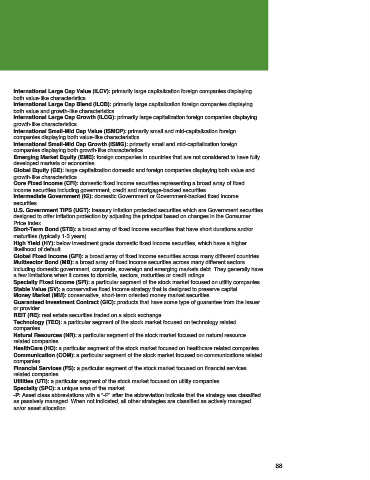
 Conservative (CON): a diversified asset allocation strategy including equity with an emphasis on fixed   International Large Cap Value (ILCV): primarily large capitalization foreign companies displaying
 income. Demonstrates a lower overall volatility (risk) level when compared to the other asset allocation   both value-like characteristics.
 categories.  International Large Cap Blend (ILCB): primarily large capitalization foreign companies displaying
 Moderate Conservative (MC): a diversified asset allocation strategy including equity and fixed income.   both value and growth-like characteristics.
 Demonstrates a higher overall volatility (risk) level when compared to CON, but lower volatility level when   International Large Cap Growth (ILCG): primarily large capitalization foreign companies displaying
 compared to MOD, MA and AGG.  growth-like characteristics.
 Moderate (MOD): a diversified asset allocation strategy including equity and fixed income. Demonstrates   International Small-Mid Cap Value (ISMCP): primarily small and mid-capitalization foreign
 a higher overall volatility (risk) level when compared to CON and MC, but lower volatility level when   companies displaying both value-like characteristics.
 compared to MA and AGG.  International Small-Mid Cap Growth (ISMG): primarily small and mid-capitalization foreign
 Moderate Aggressive (MA): a diversified asset allocation strategy including equity and fixed income.   companies displaying both growth-like characteristics.
 Demonstrates a higher overall volatility (risk) level when compared to CON, MC and MOD, but lower   Emerging Market Equity (EME): foreign companies in countries that are not considered to have fully
 volatility level when compared to AGG.  developed markets or economies.
 Aggressive (AGG): a diversified asset allocation strategy including fixed income with an emphasis on   Global Equity (GE): large capitalization domestic and foreign companies displaying both value and
 equity. Demonstrates a higher overall volatility (risk) level when compared to the other asset allocation   growth-like characteristics.
 categories.  Core Fixed Income (CFI): domestic fixed income securities representing a broad array of fixed
 Large Cap Value (LCV): large capitalization companies who have lower prices in relation to their   income securities including government, credit and mortgage-backed securities.
 earnings or book value.  Intermediate Government (IG): domestic Government or Government-backed fixed income
 Large Cap Blend (LCB): large capitalization companies who display both value and growth-like   securities.
 characteristics.  U.S. Government TIPS (UGT): treasury inflation protected securities which are Government securities
 Large Cap Growth (LCG): large capitalization companies who have higher prices relative to their   designed to offer inflation protection by adjusting the principal based on changes in the Consumer
 earnings or book value, generally due to a higher forecasted or expected growth rate.  Price Index.
 Mid Cap Value (MCV): mid-capitalization companies who have lower prices in relation to their earnings   Short-Term Bond (STB): a broad array of fixed income securities that have short durations and/or
 or book value.  maturities (typically 1-3 years).
 Mid Cap Blend (MCB): mid-capitalization companies who display both value and growth-like   High Yield (HY): below investment grade domestic fixed income securities, which have a higher
 characteristics.  likelihood of default.
 Mid Cap Growth (MCG): mid-capitalization companies who have higher prices relative to their earnings   Global Fixed Income (GFI): a broad array of fixed income securities across many different countries.
 or book value, generally due to a higher expected growth rate.  Multisector Bond (MB): a broad array of fixed income securities across many different sectors
 Small Cap Value (SCV): small capitalization companies who have lower prices in relation to their   including domestic government, corporate, sovereign and emerging markets debt. They generally have
 earnings or book value.  a few limitations when it comes to domicile, sectors, maturities or credit ratings.
 Small Cap Blend (SCB): small capitalization companies who display both value and growth-like   Specialty Fixed Income (SFI): a particular segment of the stock market focused on utility companies.
 characteristics.  Stable Value (SV): a conservative fixed income strategy that is designed to preserve capital.
 Small Cap Growth (SCG): small capitalization companies who have higher prices relative to their   Money Market (MM): conservative, short-term oriented money market securities.
 earnings or book value, generally due to a higher forecasted or expected growth rate.  Guaranteed Investment Contract (GIC): products that have some type of guarantee from the issuer
 SMid Value (SMCV): includes any fund categorized as SCV or MCV within Morningstar and whose   or provider.
 primary prospectus benchmark is the Russell 2500 Value, which consists primarily of small and mid-  REIT (RE): real estate securities traded on a stock exchange.
 capitalization companies who have lower prices in relation to their earnings or book value.  Technology (TEC): a particular segment of the stock market focused on technology related
 SMid Growth (SMCG): includes any fund categorized as SCG or MCG within Morningstar and whose   companies.
 primary prospectus benchmark is the Russell 2500 Growth, which consists primarily of small and mid-  Natural Resources (NR): a particular segment of the stock market focused on natural resource
 capitalization companies who have higher prices in relation to their earnings or book value, generally due   related companies.
 to a higher forecasted or expected growth rate.  HealthCare (HC): a particular segment of the stock market focused on healthcare related companies.
 SMid Blend (SMCB): includes any fund categorized as SCB or MCB within Morningstar and whose   Communication (COM): a particular segment of the stock market focused on communications related
 primary prospectus benchmark is the Russell 2500, which consists primarily of small and mid-  companies.
 capitalization companies who display both value and growth-like characteristics.  Financial Services (FS): a particular segment of the stock market focused on financial services
 Bank Loans (BL): an array of loans to corporations made by banks and other financial outfits that do not   related companies.
 pay a fixed interest rate, but rather an adjustable one and are therefore often referred to as floating rate   Utilities (UTI): a particular segment of the stock market focused on utility companies.
 loans.  Specialty (SPC): a unique area of the market
 International Equity (IE): includes any fund whose primary prospectus benchmark is the MSCI ACWI ex   -P: Asset class abbreviations with a “-P” after the abbreviation indicate that the strategy was classified
 USA, which includes both developed and emerging markets, and is intended to provide a broad measure   as passively managed. When not indicated, all other strategies are classified as actively managed
 of stock performance throughout the world, with the exception of U.S. based companies.   an/or asset allocation.


                                                                                            88

