


Page 410 - DCAC February 2024 Files
P. 410
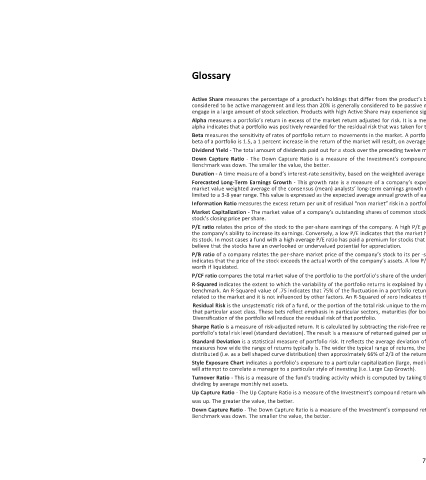
product’s generally  is  higher  or  60%  of  Share  Active  An weightings.  portfolio  on  based  index, benchmark considered to be active management and less than 20% is generally considered to be passive management. Active Share allows investors to distinguish between products that do and do not  time.  positive security selection. A  to reference  with performance  to contribution manager’s  the  of

                        the  risk. Dividend Yield ‐ The total amount of dividends paid out for a stock over the preceding twelve months divided by the closing price of a share of the common stock.  company’s  related to the market and it is not influenced by other factors. An R‐Squared of zero indicates that no relationship exists between the portfolio’s return and the market. distributed (i.e. as a bell shaped curve distributio
                        from engage in a large amount of stock selection. Products with high Active Share may experience significant deviation from the performance of benchmarks over  for  Investment’s  a  of Information Ratio measures the excess return per unit of residual “non market” risk in a portfolio. The ratio is equal to the Alpha divided by the Residual Risk. company’s outstanding shares of common stock at a specific  c
                        differ  adjusted  the  measure

                        that  return alpha indicates that a portfolio was positively rewarded for the residual risk that was taken for that level of market exposure.  of  a
                        holdings  market  measure  is  rate             bets reflect emphasis in particular sectors, portfolio’s total risk level (standard deviation). The result is a measure of returned gained per unit of total risk taken.

                        product’s  the  of  a  is  Ratio  growth limited to a 3‐8 year range. This value is expressed as the expected average annual growth of earnings in  per‐share market price of the  Standard Deviation is a statistical measure of portfolio risk. It reflects the average deviation


                        a   excess        This      P/E ratio relates the price of the stock to the per‐share earnings of the company. A believe that the stocks have an overlooked or undervalued potential for appreciation.  will attempt to correlate a manager to a particular style of investing (i.e. Large Cap Growth).
                        of  in       Capture  ‐ average of the consensus (mean)  Diversification of the portfolio will reduce the residual risk of that portfolio.
                        percentage  return  Down  Growth   relates the


                        the  portfolio’s  The  ‐ Benchmark was down. The smaller the value, the better.  Earnings  Market Capitalization ‐ The market value of a  Style Exposure Chart indicates a portfolio’s exposure to  Benchmark was down. The smaller the value, the better.
                        measures  a  Ratio  Long‐Term  value weighted  stock’s closing price per share.  company  R‐Squared indicates the extent to  that particular asset class. These  dividing by average monthly net assets.  was up. The greater the value, the better.

                   Glossary  Share  Active  measures  Alpha  Capture  Down  Forecasted  market  ratio of a  P/B  worth if liquidated.

