


Page 497 - DCAC Feb 2026 Files
P. 497
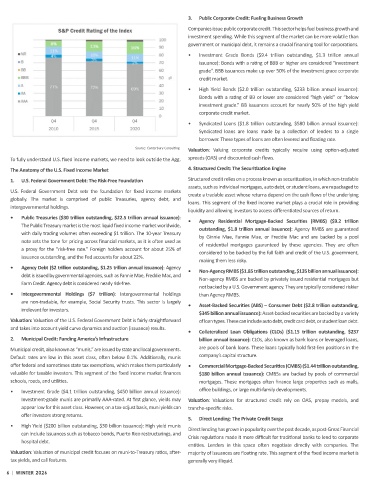
3.   Public Corporate Credit: Fueling Business Growth
                                                               Companies issue public corporate credit. This sector helps fuel business growth and
                                                               investment spending. While this segment of the market can be more volatile than
                                                               government or municipal debt, it remains a crucial financing tool for corporations.
                                                               •   Investment  Grade  Bonds  ($9.4  trillion  outstanding,  $1.3  trillion  annual
                                                                   issuance): Bonds with a rating of BBB or higher are considered “investment
                                                                   grade”. BBB issuances make up over 50% of the investment grace corporate
                                                                   credit market.

                                                               •   High  Yield  Bonds  ($2.0  trillion  outstanding,  $233  billion  annual  issuance):
                                                                   Bonds with a rating of BB or lower are considered “high yield” or “below
                                                                   investment grade.” BB issuances account for nearly 50% of the high yield
                                                                   corporate credit market.

                                                               •   Syndicated Loans ($1.8 trillion outstanding, $580 billion annual issuance):
                                                                   Syndicated  loans  are  loans  made  by  a  collection  of  lenders  to  a  single
                                                                   borrower. These types of loans are often levered and floating rate.
                                              Source: Canterbury Consulting  Valuation:  Valuing  corporate  credits  typically  require  using  option-adjusted
    To fully understand U.S. fixed income markets, we need to look outside the Agg.   spreads (OAS) and discounted cash flows.
    The Anatomy of the U.S. Fixed Income Market                4. Structured Credit: The Securitization Engine
    1.   U.S. Federal Government Debt: The Risk-Free Foundation  Structured credit relies on a process known as securitization, in which non-tradable
                                                               assets, such as individual mortgages, auto debt, or student loans, are repackaged to
    U.S.  Federal  Government  Debt  sets  the  foundation  for  fixed  income  markets   create a tradable asset whose returns depend on the cash flows of the underlying
    globally.  The  market  is  comprised  of  public  Treasuries,  agency  debt,  and   loans. This segment of the fixed income market plays a crucial role in providing
    intergovernmental holdings.
                                                               liquidity and allowing investors to access differentiated sources of return.
    •   Public Treasuries ($30 trillion outstanding, $22.5 trillion annual issuance):   •   Agency  Residential  Mortgage-Backed  Securities  (RMBS)  ($9.2  trillion
        The Public Treasury market is the most liquid fixed income market worldwide,   outstanding, $1.8 trillion annual issuance): Agency RMBS are guaranteed
        with daily trading volumes often exceeding $1 trillion. The 10-year Treasury   by  Ginnie  Mae,  Fannie  Mae,  or  Freddie  Mac  and  are  backed  by  a  pool
        note sets the tone for pricing across financial markets, as it is often used as   of  residential  mortgages  guaranteed  by  these  agencies.  They  are  often
        a proxy for the “risk-free rate.” Foreign holders account for about 25% of   considered to be backed by the full faith and credit of the U.S. government,
        issuance outstanding, and the Fed accounts for about 22%.
                                                                   making them less risky.
    •   Agency Debt ($2 trillion outstanding, $1.25 trillion annual issuance): Agency   •   Non-Agency RMBS ($1.85 trillion outstanding, $135 billion annual issuance):
        debt is issued by governmental agencies, such as Fannie Mae, Freddie Mac, and   Non-agency RMBS are backed by privately issued residential mortgages but
        Farm Credit. Agency debt is considered nearly risk-free.
                                                                   not backed by a U.S. Government agency. They are typically considered riskier
    •   Intergovernmental  Holdings  ($7  trillion):  Intergovernmental  holdings   than Agency RMBS.
        are non-tradable, for example, Social Security trusts. This sector is largely   •   Asset-Backed Securities (ABS) – Consumer Debt ($2.8 trillion outstanding,
        irrelevant for investors.
                                                                   $345 billion annual issuance): Asset-backed securities are backed by a variety
    Valuation: Valuation of the U.S. Federal Government Debt is fairly straightforward   of loan types. These can include auto debt, credit card debt, or student loan debt.
    and takes into account yield curve dynamics and auction (issuance) results.
                                                               •   Collateralized  Loan  Obligations  (CLOs)  ($1.15  trillion  outstanding,  $237
    2.   Municipal Credit: Funding America’s Infrastructure        billion annual issuance): CLOs, also known as bank loans or leveraged loans,
    Municipal credit, also known as “munis,” are issued by state and local governments.   are pools of bank loans. These loans typically hold first-lien positions in the
    Default rates are low in this asset class, often below 0.1%. Additionally, munis   company’s capital structure.
    offer federal and sometimes state tax exemptions, which makes them particularly   •   Commercial Mortgage-Backed Securities (CMBS) ($1.44 trillion outstanding,
    valuable for taxable investors. This segment of the fixed income market finances   $180 billion annual issuance): CMBSs are backed by pools of commercial
    schools, roads, and utilities.                                 mortgages. These mortgages often finance large properties such as malls,
    •   Investment Grade ($4.1 trillion outstanding, $450 billion annual issuance):   office buildings, or large multi-family developments.
        Investment-grade munis are primarily AAA-rated. At first glance, yields may   Valuation:  Valuations  for  structured  credit  rely  on  OAS,  prepay  models,  and
        appear low for this asset class. However, on a tax-adjust basis, muni yields can   tranche-specific risks.
        offer investors strong returns.
                                                               5.   Direct Lending: The Private Credit Surge
    •   High Yield ($200 billion outstanding, $30 billion issuance): High yield munis   Direct lending has grown in popularity over the past decade, as post-Great Financial
        can include issuances such as tobacco bonds, Puerto Rico restructurings, and   Crisis regulations made it more difficult for traditional banks to lend to corporate
        hospital debt.
                                                               entities.  Lenders  in  this  space  often  negotiate  directly  with  companies.  The
    Valuation: Valuation of municipal credit focuses on muni-to-Treasury ratios, after-  majority of issuances are floating rate. This segment of the fixed income market is
    tax yields, and call features.                             generally very illiquid.

   6 | WINTER 2026                                                                                                                                                                                                                     WINTER 2026 | 7

