


Page 151 - MayDefComp
P. 151
5/14/2020                                            Contract No.   061869-0001-0000
                                                                   061869-0003-0000


 Variable Return Investment
 Fund Name   Average Annual Total Return   Benchmark   Name of   Gross Total   Net Total   Investment
 as of 12/31/2019   Benchmark   Annual   Annual      Close/

                     Operating       Operating       Open/
                     Expenses        Expenses**      Freeze
                                                     Date
 1Year   5Year   10Year   1Year   5Year   10Year      As a   Per   As a   Per
 or *Since   or *Since   %   $1000   %       $1000
 Fund   Fund
 Inception   Inception
 if less   if less
 than 10   than 10
 Years   Years
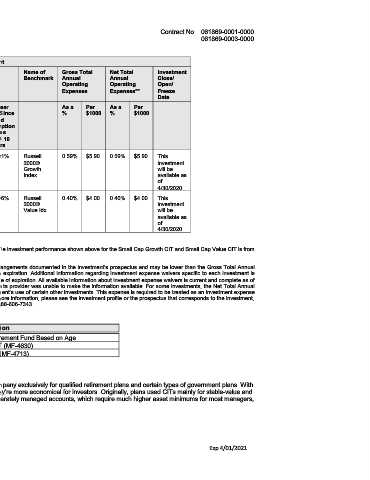
 Small Cap Growth CIT (MF-4630)   -    -   1.69%   28.50%   9.34%   13.01%   Russell   0.59%   $5.90   0.59%   $5.90   This
 www.MassMutual.com/FF/mr4630.PDF   2000®            investment
         Growth                                      will be

         Index                                       available as
 Inception Date: 08/30/2019                          of
                                                     4/30/2020
 Small Cap Value CIT (MF-4713)   -    -   12.25%   22.39%   6.99%   10.56%   Russell   0.40%   $4.00   0.40%   $4.00   This
 www.MassMutual.com/FF/mr4713.PDF   2000®            investment
         Value Idx                                   will be

                                                     available as
 Inception Date: 08/10/2019                          of
                                                     4/30/2020


 *The benchmark since inception return is calculated from the month-end of the investment's inception.  The investment performance shown above for the Small Cap Growth CIT and Small Cap Value CIT is from
 their inception dates of August 30, 2019 and August 10, 2019 respectively.

 **The Net Total Annual Operating Expenses include any investment expense waiver/reimbursement arrangements documented in the investment’s prospectus and may be lower than the Gross Total Annual
 Operating Expenses due to the indicated expense waivers or reimbursements, which may be subject to expiration. Additional information regarding investment expense waivers specific to each investment is
 included in this document, if available, including whether the waiver is contractual or voluntary and its date of expiration. All available information about investment expense waivers is current and complete as of
 the date of this report. If information regarding the waivers is incomplete, it is because our third-party data provider was unable to make the information available. For some investments, the Net Total Annual
 Operating Expense ratio figure reflects the subtraction of interest expense, which results from an investment’s use of certain other investments. This expense is required to be treated as an investment expense
 for accounting purposes, but is not payable to the investment adviser or subadvisor (if applicable). For more information, please see the investment profile or the prospectus that corresponds to the investment,
 which are both available from MassMutual. Contact the MassMutual Participant Information Center at 1-888-606-7343.


 Discontinued Investment Option   New Investment Option

 Invesco Oppenheimer Intl Bond Fad (MF-1573)   Vanguard Target Retirement Fund Based on Age
 Wells Fargo Small Company Growth Fad (MF-2218)   Small Cap Growth CIT (MF-4630)
 JP Morgan Small Cap Value Fund (MF-2026)   Small Cap Value CIT (MF-4713)


 CITs (Collective Investment Trusts)

 CITs are tax-exempt, pooled investment vehicles. They’re maintained by a bank or trust company exclusively for qualified retirement plans and certain types of government plans. With
 lower marketing, overhead and compliance-related costs than comparable mutual funds, they’re more economical for investors. Originally, plans used CITs mainly for stable-value and
 passive portfolios, but they’re now offered for a full range of investment mandates. Only separately managed accounts, which require much higher asset minimums for most managers,
 may be less expensive.


    2                                                                 Exp 4/01/2021

